Thursday, 4 April 2013

How do our coronary arteries get blocked?


Here is my summary of a very interesting article.

This article published in February, 2013.  It came to my attention in the “Melbourne Age” this week because the author, Fred A Kummerow is 98 years old.  He has had a 60-year career in cardiovascular research.  I wonder what I will be doing at 98.
I want to summarize the article, so that it is easier to digest, and in addition, the effort of summarizing will help my own understanding.  I will attach a link to the article. Please feel free to read it for yourself.  I have included the link, below.
One of the new “weapons” against heart attack is a new test.  A friend has just had it.  It is a simple non-invasive test which shows the amount of calcium build up in the branches of the coronary (heart) blood vessels.  This turns out to be a good predictor of trouble, and the calcium is easy to spot on the scan. 
So here is the article, on topic, of the actual chemical pathway of those calcium deposits in the coronary arteries.
Interaction between sphingomyelin and oxysterols contributes to atherosclerosis and sudden death
Am J Cardiovasc Dis. 2013; 3(1): 17–26.
Published online 2013 February 17

I am paraphrasing the article.
Heart disease continues to be the leading cause of death in the United States and in Australia. It turns out that oxidized lipids contribute to heart disease in two ways 1. by increasing deposition of calcium on the arterial wall, a major hallmark of atherosclerosis, and 2. by interrupting blood flow, a major contributor to heart attack and sudden death.
Oxidized cholesterol (oxysterols) increases the production of a substance called sphingomyelin, a phospholipid found in the cellular membranes of the coronary artery. This increases the sphingomyelin content in the cell membrane switches on double calcium ion receptor.  This means calcium will bind to the cell membranes. In addition sphingomyelin also interrupts the flow of blood.  It is a double whammy.
So what are these oxidized cholesterols (oxysterols)?  Wereally need to stay away from these.
They are found in oxidized fats used in commercially fried foods like fish and chips, fried chicken, in other words, fast food. No surprise there, but I never want to eat another chip as long as I live. 
Here is the big surprise. Other sources include:-
 “oxidation of cholesterol in vivo driven by consumption of excess polyunsaturated fatty acids from vegetable oils”  (article sited above).  This means your own body oxidizes the excess of polyunsaturated vegetable oils into oxysterols.  Yikes.
Smoking also leads to the increase production of sphingomyelin. As well, transfats found in some commercially produced, prepared  and pre-packaged foods  are another source of oxysterols.  Unfortunately, In Australia, there is no requirement to list transfats on food labels.
The decrease in smoking – down 43% - is not matched by the equivalent decrease in fatal heart disease  So, the downturn in smoking rates does not go far enough to explain why heart disease is still the leading cause of death in the western world. This article shows there are other factors, which we can control, which reduce our risk of heart attack  and sudden death from heart disease .

Good Bladder Habits

This is another older blog post with more than 700 views. Here it is:-


"Habit of the Week"  this week comes with a warning.  You may want to go to the toilet just reading about it.  


GOOD BLADDER HABITS

 1.       Drink two litres of fluid per day; include water, juices, and milk. 

Ahhh Coffee - special note.

   Restrict caffeine to 3 cups per day, if you don't have "urge"symptoms; Try and eliminate caffeine if urgency and frequency are problems.

2.    For that two litres go to the toilet 5 – 7 times to pass urine from when you get up to when you go to bed.

3.      Cut out ‘just in case’ visits to the toilet.

4.    Go to the toilet when you have a bouncy full  bladder sensation rather than the urethral sensation


5.    All you life have good bowel function


6.   Never hover or strain to pass urine.


Makes you think about the habits of a lifetime and all those times mum said to go "Just in case".

Sunday, 31 March 2013

Nundah Activity Centre PFI - Week 1

The first week of the pilot program - Promoting functional Independence (PFI) at the Nundah Activity Centre is underway.   We met in the hall first of all for a cuppa' and a chat
Looks like I am doing all the talking, but in fact, it was a chance to meet one another.  The centre provided a healthy, and large afternoon tea.
Then the hard work started.  We discussed the notion of functional independence and Anne Livingstone explained the context of the project in the wider scheme.  Participants received their purple books "Ageing with Vitality" (Qld Health)  and a journal, and were set to work immediately


 Smart Goals


We looked at SMART goals. These are small steps on our way to a larger ideas. Smart stands for
  • Specific
  • Measurable
  • Achievable 
  • Readiness
  • Time based.
We had a go at setting a smart goal in our journals. Everyone had a go. I wonder how the smart goals are going.

Types of Exercise 

 There are four types of exercise that older adults need to stay independent, and vital.  These are
  1.  Endurance also can be called, Cardio Vascular, or aerobic exercise
  2. Strength, 
  3. Balance
  4. Flexibility
We discussed the necessity of a warm up to prevent injuries and to prepare the mind and body for exercise.
We walked up and down the hall way a couple of times to warm up. 
 
For a strength exercise, we learned the squat, it is so important to be able to perform a squat.  It makes our legs stronger in the muscles that really need strengthening, namely the gluteal, hamstrings and quads. It is so important for daily tasks like, getting up out of a chair, bending safely and lifting a heavy load safely.

You can hold on lightly to the back of a chair or to the table while you perform your squat.  Remember,
  • bend from the hips first,
  • keep your body weight back onto your heels
  • keep your head up
  • exhale on the way up.

Technology

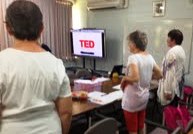
We cranked up the computer and watched a TED talk(Technology, Education and Design) featuring Laura Carstensen entitled "Older People are Happier"  We had a discussion about technology and learning typing. Texting was seen as a means of keeping in touch with the younger generation.

Next Week

Balance, smart goals, technology, Assistive Technology.

Some reading for preparation if you like.  

Have a look at: www.ilcaustralia.org.au. 
Read the next section of "Ageing with Vitality"  Section 3 and 4.
Meanwhile good luck with your smart goals.

Post a comment. just click below and type something so I know you are there.

Some thoughts - Promoting Functional Independence


Althea, Carol and Mary Clare ready for action


Fred and Norman
Here are questions to provoke us.  Let's think about what really matters to our functional independence.  It is different things for different people.  For me, driving my car allows me to work in different locations.  If I were no longer able to drive,  I would only be in Maleny teaching classes. (Luckily driving is no problem).
I would like everyone to think about the four questions of Functional Independence:-


  1.What means the most to your independence today?

  2.  What have you let slip, or abandoned, that doesn’t matter?

  3.  What have you let slip, or abandoned, that does matter?


 4.  If there was one thing or ability, you could get back, what would it be?


 Go ahead and comment, so we can have a conversation


Carol answering those questions
  
  .

Friday, 29 March 2013

Blogging, why write a Blog?

Went to a great lecture organized by the Sunshine Coast Council Libraries entitled:-
     How to write a killer blog. by Rhonda and Ernie

A blog is a conversation. 

There is the opportunity to comment (see below) and we can pursue a conversation online.  It is not a static website, it is alive.   Importantly, blog readers can read one another's comments. So when people do comment, ideas are extended far beyond whatever I come up with.   

There is never enough time in class for a good in depth conversation.  However, here on line, we can enjoy a exploring topics in some depth.


Promoting Functional Independance - Nundah

Healthy Afternoon Tea  - let's start the way we mean to go on

I am so excited that the Nundah Activity Centre project is finally underway.

Monday morning was the start of the program.  Jacky, the physiotherapist, tested the class members for balance, reach, the timed-up-and-go test and the two minute walk.

These are baseline measurements. This means that these results will be compared to the future assessments, so that any  progress can be measured.   It gave me the opportunity to meet with people and have that first preliminary chat.

The four questions about independence were handed to each class member for them to go home and think about.

  1. What is most important to your independence, right now?
  2. What have you let slip or abandoned, that doesn't matter?
  3. What have you let slip that does matter?
  4. If there were one thing or ability which you have lost that you could get back, what would it be?

These are questions to provoke us all about thinking about functional independence.  I was able to ask many class participants these questions and I got many interesting answers, which included:-
       "the bus represents freedom" "I miss taking a bath".

Let's keep thinking about what is important to us all living happy healthy, independent lives.  And let me know what you think.

 Let's start the conversation going. You can comment below.

Friday, 15 March 2013

Pelvic Floor


Pelvic Floor Issues
In  response to queries from class members and my own curiosity, I have undertaken some research into the most up-to-date information on pelvic floor and its relation to exercise.
I can confirm that the pilates undertaken in the class is correct.  I will summarise our usual teaching points:-


  • ·         Core strength and pelvic floor strength are inextricably bound together.  Pelvic floor strength supports core muscles and good posture supports the pelvic floor.
  • ·         So always undertake core strength training in the best possible posture and
  • ·         Initiate the work by drawing up the pelvic floor
  • ·         Breath is important, because of the action of the diaphragm
  • ·         Relax between repetitions.
  • ·         Match the contraction of the pelvic floor muscles to the load to be undertaken. That is for light work a “2 out of 10” effort, for regular exercises, like pilates and small weights a “4 out of 10” effort may be required, and to lift something heavy – an “8 out of 10 effort”


There was a great program on the radio, with top experts and good questions. Worth a listen of you have pelvic pain.  Here is information from the article on ABC Radio National.  The details of a podcast are as follows:- 

Here is the link to the podcast

Here is the summary of the program from the abc radio National article on their web page:

 Pelvic Pain

Broadcast:  Wednesday 6 February 2013 9:05AM
Imagine not being able to sit down, go to work or look after your kids because of an overwhelming pain in your pelvis. One of our guests, Vanessa Watson, experienced excruciating pelvic pain for several years and it's radically altered her life. Vanessa's story is not uncommon but as the causes for pelvic pain are complex; some women don't receive adequate medical treatment. So what is known about the causes and could medical treatment and services improve?

Guests and references from the program


Bettina Arndt  - Social Commentator
Dr Susan Evans - Gynaecologist and Pain Medicine Physician
Vanessa Watson
Helpful Link is Women’s Health & Research Institute of Australia.


More info can be found in a great book -  a helpful client alerted me to 
Michelle Kenway’s book:- “Inside Out:-  a complete guide to Pelvic floor safe exercises for women”


In addition, I have done some training with Mary O’Dwyer, physiotherapist.  Here is a link her web page: -  www.holditsister.com.